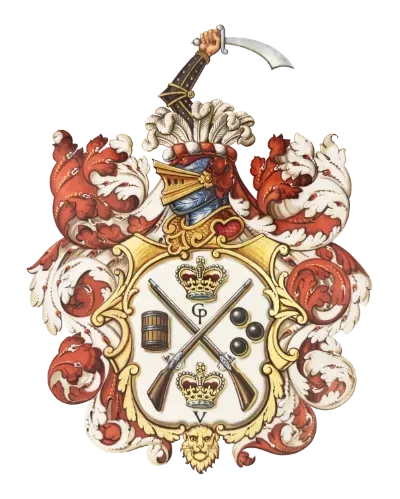
In the yellowed gaslight of a London workshop in the winter of 1877, the work began. Outside, hooves on stone streets, iron, brick and smoke. The room warm with coal heat and rich with the metallic smell of filings. Gold laying upon a scarred wooden bench. Small crucibles glowed in the furnace. Wall hung gravers, chasing tools, and fine saws. A designer, most likely the senior man in the room, bent over a full-scale drawing of an oval jewel, measuring proportions with dividers, arranging relief in his mind so that it would catch in the light.
It all started with a Captain David Aspland Gibbs, Master of the Worshipful Company of Gunmakers in 1877. On 15 November of that year, he informed the Court that he had caused a badge to be made and intended to present it to the Company.
The badge was crafted in 1878, and that date matters. It places the jewel firmly within the high Victorian period, an age of confidence, display and civic assertion. The City of London was expanding in wealth and authority. Livery companies were reasserting their ceremonial identities. Gibbs’ gift belongs to that wider moment.
Captain Gibbs was not merely embellishing the role of Master, he was seeking to enhance it by providing a lasting emblem of authority. The Mastership is annual, fleeting by design. A person holds the office for a year and then steps aside. By commissioning a permanent badge of office, Gibbs ensured that the importance of the position would have a visible, enduring centre.
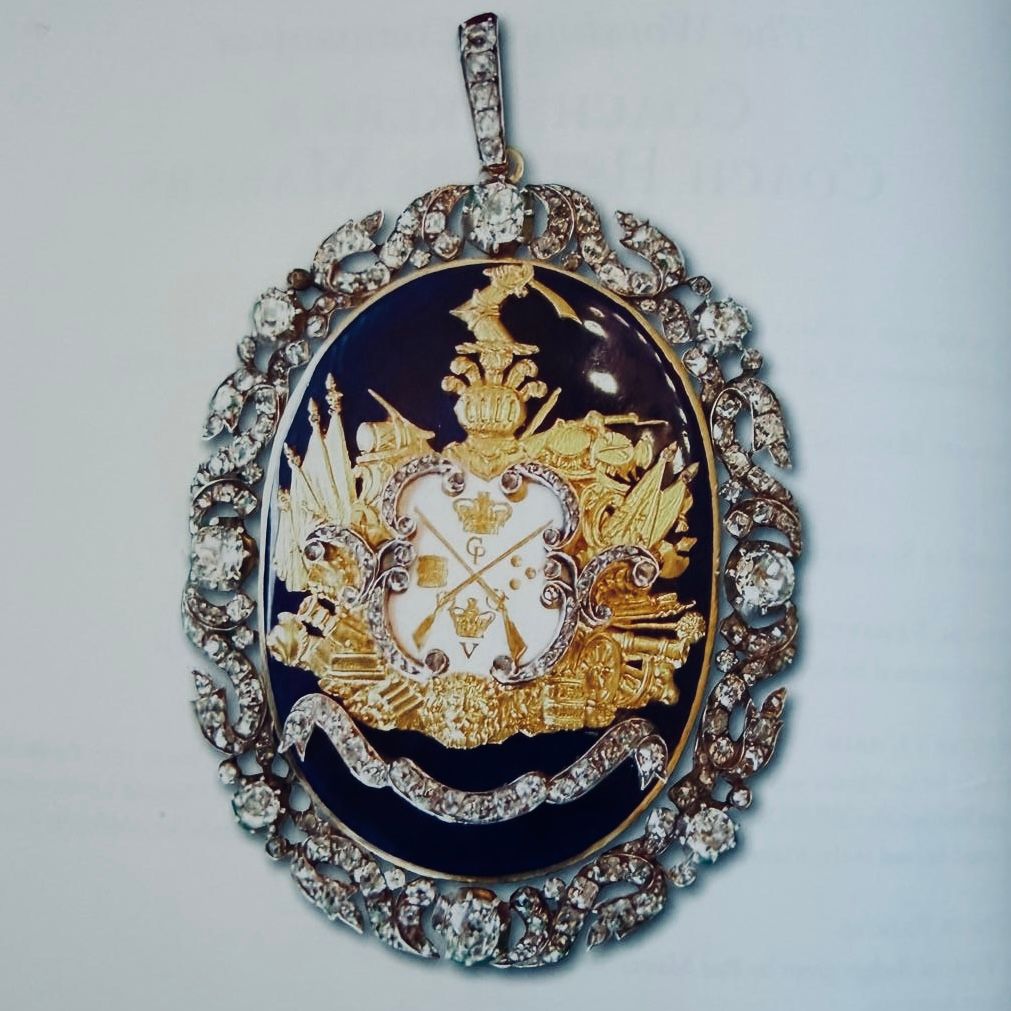
The original badge, completed in 1878, was substantial. It combined sculptural gold relief with enamelled depth, executed in the confident vocabulary of late Victorian civic design. It was made to be seen across a hall, to catch gaslight, to project gravitas. It was not restrained for the time.
Yet the story did not end with its completion.
In May 1884, the Court was informed that the executors of William John Payne, Esquire, Coroner of the City of London, had conveyed a bequest. Payne, himself a former Master, had left a jewelled ornament to the Company with the intention that a diamond border should enclose the arms upon the Master’s badge. Six years after its creation, the badge was transformed. The addition of the diamond frame in 1884 altered its character without altering its purpose. The sculptural, heraldic core remained intact, but it was now encircled by light. The openwork scroll frame, set with graduated diamonds, elevated the badge from formal regalia to something approaching high ceremonial jewellery. It did not compete with the central design; it amplified it.
This second benefaction was not an embellishment for vanity. It was an act of civic generosity. Payne’s gift framed the authority of the Master in brilliance, ensuring that the jewel would hold its own among the insignia of other great City companies. Where Gibbs had established permanence, Payne added radiance.
The reverse inscription records both names. It binds their contributions together: the presentation of the badge by Captain David Aspland Gibbs and the bequest of the jewelled frame by William John Payne. Two Masters, separated by years, joined permanently.
The gaslight has long since dimmed. The smoke-blackened skyline has given way to glass and steel. The City now hums with servers instead of steam, algorithms instead of apprentices, global markets instead of river barges. But the Livery endures, and the badge remains. It rests today against a Master’s gown in rooms lit by electric light and catches in the reflections of smartphone screens. It witnesses speeches about innovation, compliance, international trade and artificial intelligence. It stands at the intersection of heritage and relevance.
What was conceived in Victorian confidence now anchors a very twenty-first-century institution. Unchanged in substance and still serving the needs of the day.